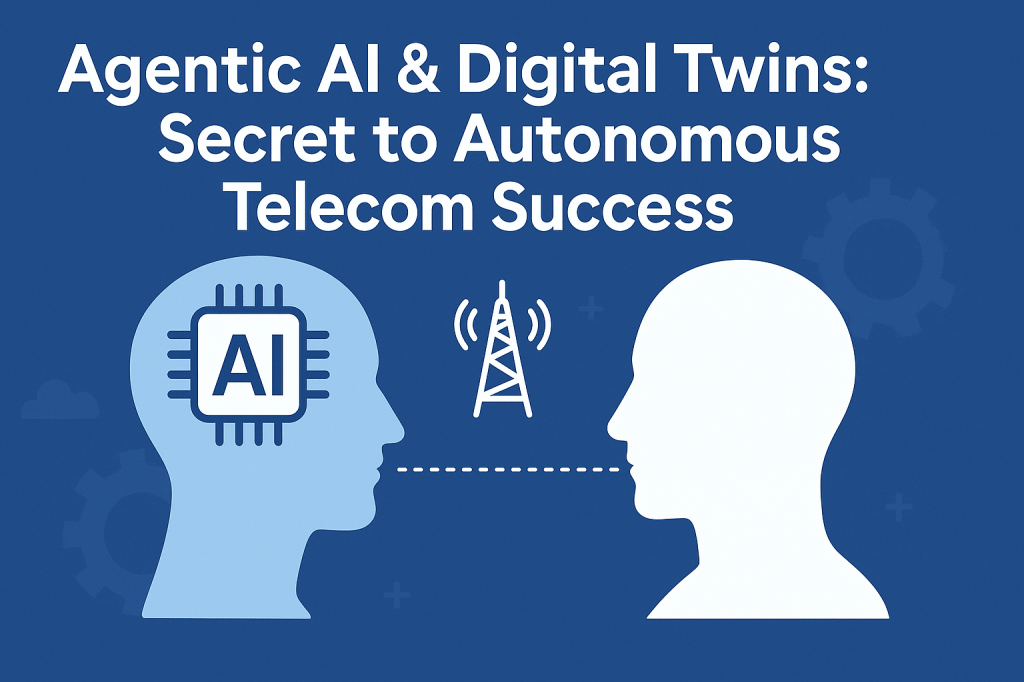
Understanding Agentic AI
Agentic AI is a new generation of artificial intelligence that goes beyond traditional automation. Unlike basic AI systems that follow strict rules, Agentic AI works with an “agent-like” mindset. These AI agents operate with a clear objective and make independent decisions to achieve their goals. They don’t just process data—they analyze, reason, and take actions without waiting for direct human commands.
For example, in a telecom network, an AI agent could monitor millions of connected devices, detect abnormal behavior, and proactively fix issues before they affect customers. It doesn’t simply respond to instructions—it acts like a problem-solver. Over time, these agents learn from past experiences and continuously improve their decision-making. This makes telecom operations more intelligent and adaptive in real time.
- Goal-Oriented Decision Making: AI agents focus on achieving specific network objectives like reducing downtime, optimizing traffic, or improving coverage.
- Continuous Learning: They learn from historical data, live feedback, and predictive models, making their decisions smarter over time.
- Autonomous Action: Instead of waiting for human approval, they act instantly to fix or optimize networks.
Understanding Digital Twins
Digital Twins are highly accurate virtual replicas of physical systems—in this case, telecom networks. They mirror every aspect of the network’s infrastructure, including hardware, software, traffic flow, and user interactions. This digital version is constantly updated with real-time data, making it a living model of the actual network.
With a Digital Twin, telecom operators can simulate different scenarios without touching the live network. They can test new configurations, forecast network performance under heavy traffic, or evaluate how a new 5G upgrade would behave before deployment. This eliminates guesswork and reduces the risk of costly mistakes.
- Real-Time Synchronization: Digital Twins are updated continuously with live data from sensors and network monitoring tools.
- Risk-Free Testing: Telecom providers can test upgrades, security patches, or new services in a safe virtual environment before applying them live.
- Predictive Insights: By analyzing historical and live data, Digital Twins forecast network issues and capacity needs in advance.
How They Work Together
The real power comes when Agentic AI and Digital Twins work in synergy. The Digital Twin provides a safe, realistic simulation of the telecom network, while Agentic AI uses it as a learning ground. AI agents can experiment with different optimization strategies inside the Digital Twin before applying them in the live network. This ensures safer, faster, and more efficient decision-making.
Imagine a scenario where a network congestion issue arises. The AI agent first runs simulations in the Digital Twin to find the best fix—like rerouting data or reallocating bandwidth. Once it confirms the solution works, it applies it directly in the live network. This feedback loop makes telecom networks self-improving over time.
- Learning in a Safe Environment: AI can make mistakes inside the Digital Twin without risking real network performance.
- Faster Optimization: The AI quickly identifies the best solutions and applies them in real networks.
- Continuous Improvement: The AI keeps refining its strategies as the Digital Twin evolves with live data.
Why Telecom Needs This Transformation
Challenges in Modern Telecom
The telecom industry is evolving faster than ever. With the rise of 5G networks, IoT devices, and edge computing, traditional network management methods are no longer sufficient. Telecom providers are under constant pressure to deliver high-speed, low-latency, and ultra-reliable services—all while managing growing infrastructure complexity. Let’s look at the biggest challenges:
- Increasing Network Complexity: A single telecom operator manages millions of connected devices, multiple layers of infrastructure, and thousands of network configurations. This complexity makes manual monitoring and troubleshooting nearly impossible.
- Rising Customer Expectations: Users expect seamless streaming, lag-free gaming, and always-on connectivity. Even a few minutes of downtime can lead to customer dissatisfaction and churn.
- High Operational Costs: Maintaining large-scale networks requires huge teams and resources. Any inefficiency directly impacts profit margins.
- Unpredictable Traffic Patterns: With IoT sensors, connected cars, and smart cities, network demand is becoming highly dynamic. Operators can’t always predict usage spikes accurately.
- Security Risks: As networks become more software-driven, they’re also more vulnerable to cyberattacks. Detecting and mitigating threats manually is slow and risky.
The Need for Smarter, Autonomous Networks
Telecom networks can no longer rely on manual processes and reactive troubleshooting. They need systems that can predict problems, fix themselves, and adapt to changing demand in real time. This is where Agentic AI and Digital Twins bring transformative value.
For example, instead of waiting for a network outage to occur and then deploying engineers, an AI agent can detect early warning signals and automatically reroute traffic. Similarly, a Digital Twin can simulate the impact of a new 5G deployment before it goes live, preventing costly mistakes.
In short, telecom providers need a proactive and predictive approach rather than a reactive one. Autonomous systems powered by Agentic AI and Digital Twins enable telecom operators to stay ahead of problems instead of constantly chasing them.
The Promise of Automation
Automation powered by AI and Digital Twins helps telecom companies:
- Reduce downtime: AI predicts and fixes network issues before customers even notice them.
- Cut operational costs: Automated decision-making eliminates the need for large manual teams.
- Improve customer experience: Networks stay optimized, offering faster and more reliable services.
- Accelerate innovation: With Digital Twins, new services can be tested and deployed much faster, without risking live operations.
This transformation is not just about efficiency—it’s about future-proofing telecom networks. As demand for bandwidth, speed, and reliability keeps growing, only autonomous networks can scale without human limitations.
How Agentic AI Changes Network Operations
Self-Healing Networks
One of the biggest advantages of Agentic AI in telecom is the ability to create self-healing networks. In traditional systems, when a fault occurs, it’s detected only after customers experience disruptions. Engineers then diagnose the problem, which takes time and effort. With Agentic AI, this entire process becomes proactive.
AI agents continuously monitor every aspect of the network—signal strength, bandwidth usage, latency, and device behavior. If they detect an unusual pattern, they don’t just send an alert—they take action immediately. For example, if a cell tower is about to fail, the AI can automatically reroute traffic to nearby towers, avoiding service disruption altogether.
Over time, these AI agents learn from past incidents and improve their fault detection accuracy. This means fewer outages, better reliability, and a significant reduction in operational costs. For telecom providers, this kind of predictive maintenance is a game changer.
- Instant fault detection: AI spots network issues in real time before they escalate.
- Automatic rerouting: Traffic is shifted intelligently to maintain service quality.
- Predictive maintenance: AI identifies weak points in the network to prevent future failures.
Proactive Optimization
Beyond fixing problems, Agentic AI also helps optimize network performance proactively. Telecom networks constantly face fluctuating demand—think about peak hours when millions stream videos or play online games simultaneously. Traditional systems can’t always balance this load efficiently.
AI agents analyze traffic patterns in real time and make intelligent decisions to allocate resources where they’re needed most. For example, during a big sports event, the AI can increase bandwidth in that specific region, ensuring viewers get smooth streaming without interruptions. Similarly, it can balance data loads across different network layers to avoid congestion.
This level of dynamic optimization ensures that every user enjoys the best possible service, even during unexpected traffic surges. It also helps telecoms reduce energy consumption by using resources more efficiently.
- Dynamic bandwidth allocation: AI adjusts capacity based on real-time demand.
- Load balancing: Traffic is distributed intelligently to prevent bottlenecks.
- Energy efficiency: AI minimizes unnecessary power usage by optimizing resources.
Automated Customer Support
Agentic AI doesn’t just work behind the scenes on the network—it also improves customer-facing services. Telecom companies often struggle with high call volumes, slow response times, and repetitive queries. AI-powered virtual agents can handle a large percentage of these interactions instantly.
For example, if a customer experiences slow internet, the AI chatbot can immediately run diagnostics on their connection. It can suggest quick fixes, push configuration updates remotely, or escalate the issue to a human technician only if necessary. This speeds up resolution times and improves customer satisfaction.
Moreover, AI learns from customer behavior. It can personalize recommendations, offer new plans based on usage patterns, and even predict when a customer might consider switching providers—helping telecom companies proactively retain them.
- 24/7 virtual assistance: AI chatbots provide instant support without waiting times.
- Smart diagnostics: AI can troubleshoot and fix common issues automatically.
- Personalized services: AI recommends tailored solutions based on user history and preferences.
In summary, Agentic AI transforms telecom operations by making networks self-healing, adaptive, and customer-centric. It reduces human effort, improves reliability, and creates smarter experiences for both operators and users.
The Role of Digital Twins in Telecom
Creating a Virtual Replica of Networks
Digital Twins in telecom are more than just network diagrams or static models. They are living, breathing virtual replicas of entire network infrastructures. These twins are synchronized in real time with live data from the actual network. Every change—whether it’s a spike in traffic, a new device connection, or a hardware failure—is instantly reflected in the twin.
This real-time synchronization allows telecom providers to see the complete picture of their network at any moment. Instead of relying on scattered monitoring tools, operators can interact with a unified virtual model that behaves exactly like the real network. They can zoom into specific regions, analyze performance metrics, and identify hidden issues that aren’t visible in traditional dashboards.
- Real-time mirroring: The Digital Twin continuously updates with live network data.
- Detailed visualization: Operators gain full visibility of the network’s physical and virtual layers.
- Unified network insights: Everything from traffic flow to device performance is tracked in one place.
Simulating Network Upgrades
Telecom networks are constantly evolving—adding new towers, deploying 5G, integrating IoT devices, and upgrading software. But rolling out these upgrades in a live environment is risky and expensive. A small configuration mistake can cause large-scale outages.
With Digital Twins, telecom operators can test and validate every change in a safe, virtual environment. For example, before deploying a new 5G layer in a city, the Digital Twin can simulate how it will interact with existing 4G infrastructure, how much bandwidth it will require, and how it will affect customer devices. If any performance bottlenecks appear, they can be fixed in the simulation before the real deployment.
This “test-before-you-apply” approach significantly reduces rollout risks, speeds up innovation, and saves millions in potential downtime costs.
- Risk-free testing: Every upgrade is validated in a virtual model first.
- Performance prediction: Operators can see how new technologies will behave before going live.
- Faster rollouts: Network expansions and updates can be deployed confidently and quickly.
Predicting and Preventing Failures
Digital Twins don’t just simulate the present—they also predict the future. By combining live data with historical trends, they can forecast how the network will behave under different conditions. For example, if the twin predicts that a certain region will face high data congestion during a major event, telecom operators can take preventive measures in advance.
Similarly, Digital Twins can identify weak spots in the network that are prone to hardware failures or security breaches. This allows operators to take action before an issue occurs, reducing downtime and enhancing reliability.
When paired with Agentic AI, the predictive power becomes even stronger. AI agents can run thousands of “what-if” scenarios in the Digital Twin and recommend the best solutions—without affecting the live network. This makes the entire telecom system more resilient and self-aware.
- Predictive analytics: Digital Twins forecast traffic demand, potential failures, and capacity needs.
- Proactive problem-solving: Operators can fix vulnerabilities before they impact users.
- Enhanced resilience: The network adapts to changing conditions with fewer surprises.
In essence, Digital Twins turn telecom networks into intelligent, future-ready systems. They provide a safe playground for testing, predicting, and improving, making network management more precise and less risky.
Benefits of Combining Agentic AI and Digital Twins
Enhanced Decision-Making
When Agentic AI and Digital Twins work together, they create a powerful ecosystem for smarter decision-making. The Digital Twin serves as a safe and realistic testing ground, while Agentic AI acts as the brain that learns, predicts, and decides the best course of action.
For example, if a network is nearing congestion, the AI agent can simulate multiple solutions inside the Digital Twin—like rerouting traffic, increasing capacity, or balancing loads. It then selects the most effective solution and applies it to the live network. This approach eliminates guesswork and reduces risks associated with complex network decisions.
This synergy also helps telecom operators plan for the future. They can simulate how a new 5G rollout will affect traffic demand, customer experience, and resource allocation, then use AI to recommend the optimal strategy. In other words, decisions become data-driven, predictive, and highly reliable.
- Safe experimentation: AI tests multiple scenarios in the Digital Twin without impacting live networks.
- Faster insights: AI agents analyze massive amounts of data instantly to find the best solutions.
- Accurate planning: Operators can make smarter long-term investments based on AI simulations.
Faster Deployment of New Services
Telecom companies are constantly introducing new services, from 5G networks to IoT-based smart city solutions. But deploying new technologies at scale is risky and time-consuming. A single mistake in a network update can lead to costly downtime and customer frustration.
By combining Agentic AI and Digital Twins, telecom operators can accelerate their service deployments. The Digital Twin allows them to test and fine-tune new configurations in a virtual environment. Once the AI confirms that the deployment is safe and optimized, it can roll out the changes automatically in the live network.
This reduces the time it takes to launch new services, improves rollout accuracy, and ensures a smooth experience for customers. It also minimizes the need for large manual teams, saving operational costs.
- Risk-free rollouts: New updates are fully tested before live deployment.
- Reduced time-to-market: Telecoms can launch services much faster.
- Cost efficiency: Automated deployment reduces manpower and resource needs.
Reduced Operational Costs
Telecom networks traditionally require large teams for monitoring, troubleshooting, and upgrading infrastructure. These manual processes are expensive and prone to delays. By combining Agentic AI with Digital Twins, operators can achieve a high level of automation that significantly reduces operational costs.
For example, instead of dispatching technicians to diagnose a network fault, AI agents can identify the problem remotely, simulate the fix in the Digital Twin, and apply it automatically. This reduces truck rolls, labor hours, and downtime penalties.
Moreover, AI-driven optimization also reduces energy consumption. By dynamically adjusting bandwidth and resource allocation, telecom providers can operate more sustainably while saving money.
- Lower maintenance costs: AI predicts and prevents failures, reducing emergency repairs.
- Less manual work: Most network operations become fully automated.
- Energy savings: AI optimizes resource usage for better efficiency.
Improved Customer Experience
At the end of the day, the biggest benefit of combining Agentic AI and Digital Twins is the impact on customer satisfaction. Users want seamless streaming, lag-free gaming, and always-on connectivity. With these technologies, telecom networks can deliver exactly that—without disruptions.
For example, if a sudden traffic surge occurs, the AI can instantly reroute traffic to maintain smooth performance. If a customer faces connectivity issues, the AI chatbot can troubleshoot and fix it without human intervention. Even before users notice a problem, the network is already taking corrective action.
Better reliability, faster response times, and personalized services lead to happier customers, fewer complaints, and stronger brand loyalty.
- Seamless connectivity: AI prevents network slowdowns before they affect users.
- Instant problem resolution: AI-driven support reduces downtime for customers.
- Personalized services: AI tailors offers and recommendations based on user needs.
Together, Agentic AI and Digital Twins make telecom networks smarter, faster, more reliable, and more cost-effective. They enable telecom companies to stay ahead in a competitive market while delivering exceptional value to their customers.
Conclusion
The telecom industry is entering a new era where automation, intelligence, and adaptability are no longer optional—they’re essential. Agentic AI and Digital Twins are at the heart of this transformation. By working together, they enable networks that are not only self-healing and proactive but also predictive and future-ready.
With Agentic AI, telecom providers can make real-time decisions, automate troubleshooting, optimize resources, and deliver seamless experiences to their customers. With Digital Twins, they gain a safe and realistic virtual environment to simulate upgrades, predict failures, and plan future network expansions without risking live operations.
When combined, these technologies create a powerful ecosystem of autonomy. They reduce operational costs, accelerate service deployments, and dramatically improve customer satisfaction. For telecom companies, this means staying competitive in a fast-changing market while building smarter and more resilient infrastructures.
But building such advanced AI-driven telecom systems requires specialized expertise. If you want to harness the true potential of AI agents and digital twin technologies, partnering with the right experts is crucial. That’s where AI Agent Development Companies come in. These companies bring deep knowledge of AI architectures, network automation, and simulation models to create solutions tailored for telecom operations.
By collaborating with the right AI partner, telecom operators can unlock autonomous network intelligence—reducing downtime, enhancing scalability, and improving overall user experience. The future of telecom belongs to those who embrace this shift today.
 TechX
TechX 
Leave a comment