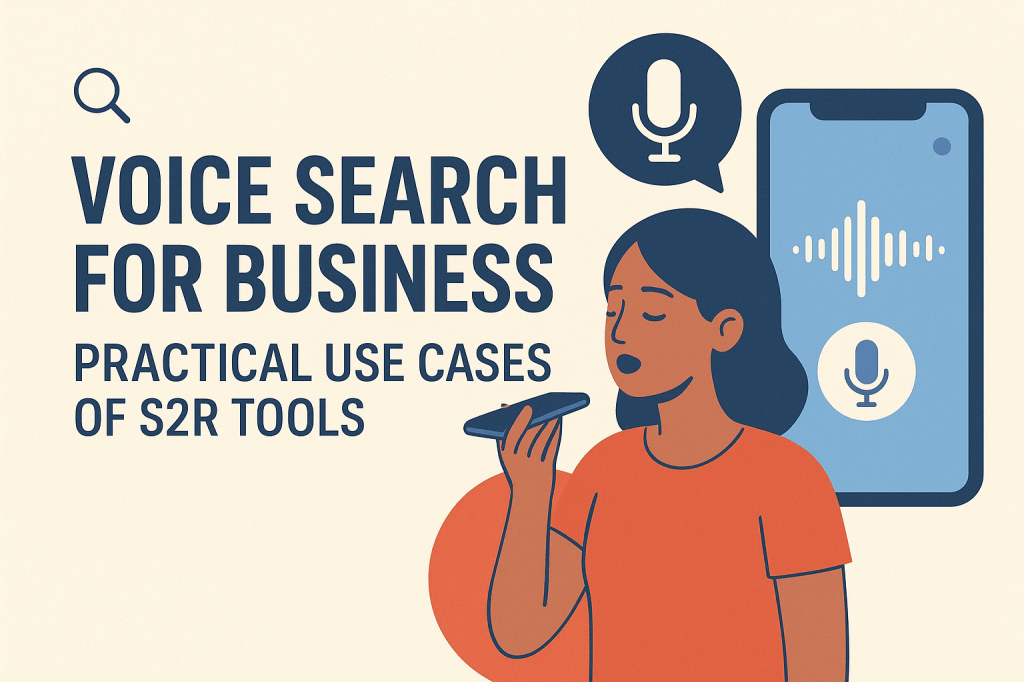
In recent years, voice search has completely transformed the way people interact with technology. With the proliferation of smart devices, virtual assistants like Alexa, Siri, Google Assistant, and Cortana have become part of daily life. Users are increasingly expecting the convenience of speaking their queries rather than typing, whether they are searching for information, shopping online, or seeking customer support. This shift has significant implications for businesses, as traditional web search and typing-based interactions are no longer sufficient to meet modern consumer expectations.
At the core of this transformation are Speech-to-Text Recognition (S2R) tools. These tools convert spoken language into text, enabling applications to understand, process, and respond to user commands accurately. By bridging the gap between human speech and digital systems, S2R tools allow businesses to create faster, more intuitive, and highly interactive experiences. For companies interested in exploring the technical details and practical applications of these tools, you can refer to Speech-to-Retrieval tools.
The integration of voice search and S2R tools is no longer just a trend; it has become a strategic necessity for businesses that want to stay competitive. From improving customer experience and boosting operational efficiency to gaining deeper consumer insights, the practical applications of S2R tools are vast. This article will explore real-world use cases, demonstrating how businesses across industries are leveraging voice search to innovate, engage, and grow.
1. Customer Support and Service
Customer support has always been a critical function for businesses, yet it has traditionally been resource-intensive and time-consuming. Long wait times, repetitive queries, and complex phone menus can frustrate customers and strain support teams. S2R tools are now transforming this space by enabling businesses to handle customer interactions more efficiently, intelligently, and personally.
With voice search integration, customers can ask questions naturally, as they would in a conversation with a human agent. These spoken queries are instantly converted into text using S2R technology, which the system then analyzes to provide accurate responses or route the request to the right department. This process reduces friction, shortens response times, and enhances the overall customer experience.
- Interactive Voice Response (IVR) enhancement: Traditional IVR systems often force customers to navigate complicated menus. By integrating S2R, businesses can enable natural language queries, allowing customers to simply describe their issue verbally and receive immediate assistance.
- Automated support for common queries: Many companies use S2R tools to automatically handle frequently asked questions, such as account balances, order status, or return policies, freeing up human agents for more complex issues.
- Multilingual support: S2R tools can recognize and transcribe multiple languages, enabling global businesses to offer seamless support to a wider audience without hiring additional staff.
For example, in the banking sector, customers can call a support line, ask questions like “What is my current account balance?” or “Transfer $200 to my savings account,” and receive immediate results without waiting for a human agent. Similarly, in telecom, users can inquire about plan details, data usage, or service issues using natural speech, which the system processes efficiently.
The integration of S2R in customer support not only improves response times but also enhances accuracy, reduces human error, and provides detailed insights into customer behavior. By analyzing the transcribed voice queries, businesses can identify common pain points, improve service offerings, and tailor responses to meet customer expectations more effectively. This creates a cycle of continuous improvement that benefits both the company and the customer.
Ultimately, S2R tools in customer support help businesses achieve two critical goals: providing faster, more accurate assistance while optimizing internal resources. Companies adopting this technology are not only enhancing customer satisfaction but also gaining a strategic advantage in a competitive market.
2. Market Research and Consumer Insights
In today’s competitive business landscape, understanding customer needs, preferences, and behaviors is essential. Traditional market research methods such as surveys, interviews, and focus groups can be time-consuming, expensive, and prone to human error. S2R tools are revolutionizing this process by enabling businesses to collect, transcribe, and analyze spoken feedback quickly and accurately.
Voice-enabled surveys allow participants to respond naturally using speech instead of typing or filling out forms. This approach increases response rates, captures more authentic opinions, and reduces the friction often associated with digital surveys. Similarly, focus group discussions and one-on-one interviews can be automatically transcribed in real-time, eliminating the need for manual note-taking and allowing researchers to focus on interpreting insights rather than documenting them.
- Voice-enabled surveys: Participants can answer questions verbally, making the process faster and more convenient, while providing richer, more nuanced feedback.
- Transcription of interviews and focus groups: Real-time transcription ensures that no important details are missed, and the data is instantly available for analysis.
- Sentiment analysis: Once transcribed, responses can be analyzed using AI tools to detect positive, negative, or neutral sentiment, helping businesses understand consumer emotions and preferences.
- Trend identification: S2R data can reveal emerging patterns in customer behavior or product feedback, enabling companies to adjust strategies proactively.
For example, a consumer electronics company can conduct a focus group to test a new smart device. Participants can describe their impressions verbally, and S2R technology captures every nuance of their feedback. Analysts can then quickly identify recurring complaints or praised features, enabling the company to refine product design and marketing strategies before launch.
Similarly, e-commerce businesses can use voice-based product reviews or customer support calls as a source of market insights. By analyzing transcribed conversations, businesses can determine what features customers value most, detect pain points in the user experience, and optimize offerings accordingly.
The benefits of integrating S2R tools into market research are significant. Companies gain faster access to high-quality data, reduce the labor and costs associated with manual transcription, and improve the accuracy of insights. Additionally, businesses can respond to trends and feedback more rapidly, keeping them ahead of competitors and better aligned with customer expectations.
Overall, S2R tools make market research and consumer insights more efficient, data-driven, and actionable. By leveraging voice data, companies can build a deeper understanding of their audience, enhance product development, and create marketing strategies that truly resonate with customers.
For businesses interested in exploring the next level of voice technology applications, S2R tools play a critical role in the broader ecosystem of Speech-to-Retrieval solutions, combining voice recognition with intelligent retrieval to deliver highly relevant insights.
3. Sales and E-commerce
The e-commerce landscape is evolving rapidly, and businesses are constantly looking for ways to make shopping more convenient, personalized, and efficient. Voice search, powered by S2R tools, is becoming an essential technology for online retailers, as it allows users to find products and make purchases simply by speaking.
Shoppers no longer need to type detailed search queries or navigate complex menus. By using voice commands, they can ask for specific products, filter options by price, brand, or features, and receive instant results. This reduces friction in the shopping experience, making it faster and more enjoyable.
- Voice-enabled product discovery: Customers can speak natural queries such as “Show me waterproof running shoes under $100” or “Find eco-friendly kitchen appliances.” S2R tools convert these queries into actionable text and return relevant search results immediately.
- Personalized recommendations: Based on previous purchases, browsing history, and spoken queries, businesses can provide tailored suggestions, enhancing engagement and increasing the likelihood of conversion.
- Voice-activated checkout: Some platforms allow customers to complete transactions using voice commands, simplifying the payment process and reducing cart abandonment.
- Real-time inventory and promotions: Voice search can integrate with live inventory systems and highlight promotions, ensuring that customers always receive up-to-date information on product availability and discounts.
For example, a fashion retailer using S2R tools can enable a customer to ask, “Find summer dresses in size medium with a discount of at least 20%,” and instantly receive a curated list of products. Similarly, electronics stores can allow users to say, “Compare the latest smartphones under $500,” helping them make quicker, informed decisions.
The integration of S2R technology in sales and e-commerce offers multiple business advantages. It not only improves the customer experience but also increases engagement, reduces search time, and drives higher conversion rates. By analyzing voice queries, retailers can gain insights into consumer preferences, trending products, and frequently asked questions, which can inform marketing and inventory strategies.
Furthermore, voice-enabled e-commerce aligns with the growing popularity of smart home devices, wearable technology, and mobile assistants. As consumers increasingly interact with these devices, businesses that provide seamless voice shopping experiences position themselves at the forefront of innovation, capturing a wider audience and staying ahead of competitors.
4. Internal Business Operations
S2R tools are not only transforming customer-facing functions, but they are also having a significant impact on internal business operations. Day-to-day tasks such as meetings, reporting, note-taking, and documentation can be time-consuming and prone to human error. By integrating voice search and speech-to-text technology, businesses can streamline these processes and improve overall productivity.
One of the key applications of S2R tools internally is automated transcription. Meetings, brainstorming sessions, and team discussions can be recorded and instantly converted into accurate text. This eliminates the need for manual note-taking, reduces errors, and allows employees to focus on the discussion rather than documentation.
- Voice-driven documentation: Employees can dictate meeting notes, reports, or project updates verbally, saving time and ensuring that all critical information is captured.
- Searchable transcripts: Transcribed content can be stored in a central repository, making it easy to search, retrieve, and share information across teams and departments.
- Task management and reminders: Voice commands can be used to schedule meetings, set reminders, or manage calendars, reducing administrative workload and improving efficiency.
- Enhanced collaboration: Teams can use voice-enabled tools to document ideas in real-time during collaborative sessions, ensuring that everyone has access to the same accurate information.
For example, a marketing team conducting a product launch planning session can use S2R tools to record the entire discussion. The transcription can then be analyzed to identify key action points, assign responsibilities, and ensure that deadlines are met. Similarly, in legal or consulting firms, accurate voice transcriptions of client meetings or case discussions can save hours of manual work and reduce the risk of miscommunication.
S2R tools also facilitate remote and hybrid work environments. Employees participating in virtual meetings can speak freely while the system captures everything, making collaboration more seamless regardless of location. This is particularly valuable in global organizations with teams spread across different time zones and languages.
Overall, incorporating S2R tools into internal business operations enhances efficiency, reduces manual labor, and ensures that valuable information is captured accurately. By automating routine tasks, employees can focus on strategic initiatives and higher-value work, which ultimately drives productivity, decision-making, and business growth.
5. Marketing and Engagement
Marketing in the digital era is evolving rapidly, and businesses are exploring innovative ways to connect with their audience. Voice search and S2R tools offer unique opportunities to engage customers more naturally and personally, making marketing campaigns more interactive, targeted, and effective.
One of the main advantages of voice-enabled marketing is the ability to create conversational experiences. Unlike traditional ads that are passive, voice interactions allow users to respond, ask questions, and receive immediate feedback. This two-way interaction increases engagement, builds brand awareness, and improves customer recall.
- Voice-enabled advertisements: Businesses can create ads that users interact with using voice commands, such as requesting more information, signing up for promotions, or exploring related products.
- Voice search optimization (VSO): Optimizing content for voice queries ensures that brands appear in results when users search using natural language, which is becoming increasingly common with smart assistants.
- Interactive campaigns: S2R tools allow marketers to run quizzes, surveys, and gamified experiences via voice, encouraging users to engage actively with the brand.
- Personalized engagement: By analyzing voice queries and interactions, businesses can deliver tailored recommendations, offers, and content that resonate with individual customers.
For example, a travel agency could use voice-enabled campaigns to let customers ask, “Find family-friendly vacation packages in Europe under $2000,” and provide personalized options instantly. Similarly, a retail brand could enable voice interaction to guide customers through product comparisons or seasonal promotions, creating a more immersive shopping experience.
S2R tools also help marketers analyze voice interactions to gain insights into customer preferences, frequently asked questions, and emerging trends. These insights can inform content strategy, product recommendations, and ad targeting, ensuring marketing efforts are data-driven and highly relevant.
Moreover, voice marketing aligns with the growing adoption of smart home devices, mobile assistants, and wearable technology. As more consumers interact with these devices, brands that provide seamless, voice-friendly experiences can establish a competitive edge and create stronger customer loyalty.
In summary, S2R tools in marketing and engagement enable businesses to create interactive, personalized, and conversational experiences that drive awareness, engagement, and conversions. By leveraging voice technology, companies can connect with customers in a way that feels natural, intuitive, and aligned with modern consumer behavior.
6. Accessibility and Inclusivity
One of the most important benefits of S2R tools is their ability to enhance accessibility and promote inclusivity. Voice search enables people with disabilities, such as visual impairments or mobility challenges, to interact with digital products and services more easily. By incorporating voice technology, businesses can make their platforms usable for everyone, demonstrating both social responsibility and forward-thinking innovation.
- Support for visually impaired users: Voice commands allow users who cannot see or navigate traditional interfaces to search for information, access content, and perform tasks without relying on screens or keyboards.
- Assistance for mobility-challenged individuals: S2R tools reduce the need for typing or clicking, enabling users with limited mobility to control applications, complete transactions, or interact with services using simple voice commands.
- Compliance with accessibility standards: By integrating S2R technology, businesses can meet legal requirements and industry standards for accessibility, ensuring that all users have equitable access to digital platforms.
- Inclusive experiences for diverse audiences: Multilingual S2R tools allow businesses to communicate with users in multiple languages, broadening reach and making services more inclusive for global audiences.
For example, an e-commerce platform can allow visually impaired users to search for products, read product descriptions, and complete purchases entirely through voice commands. Similarly, online education platforms can use S2R tools to enable students with disabilities to participate in classes, submit assignments, and engage with instructors using voice input.
Implementing voice search technology for accessibility also aligns with corporate social responsibility initiatives. It shows that a company values all users, fosters loyalty, and builds a reputation as a brand that cares about inclusivity. Beyond social impact, accessibility features can also lead to increased adoption and engagement by making services easier to use for a broader audience.
In conclusion, S2R tools not only enhance convenience and efficiency but also serve as a powerful means to promote inclusivity and accessibility. By investing in voice technology, businesses can create a more equitable and user-friendly experience, reaching audiences who might otherwise face barriers to digital engagement.
Conclusion
The adoption of voice search and S2R tools is fundamentally reshaping how businesses operate, interact with customers, and engage with the market. From automating customer support to enhancing internal operations, streamlining sales processes, driving marketing campaigns, and promoting accessibility, these tools provide tangible benefits across every aspect of business operations. Companies that embrace S2R technology gain faster workflows, better insights, improved customer experiences, and a competitive edge in an increasingly digital and voice-driven world.
Customer support becomes faster, more accurate, and personalized, while market research becomes data-rich, efficient, and actionable. In sales and e-commerce, voice search simplifies product discovery and improves conversions, while internal operations benefit from automated documentation, searchable transcripts, and streamlined collaboration. Marketing teams can leverage conversational campaigns and personalized engagement strategies, and accessibility improvements ensure services are inclusive and socially responsible.
As AI-driven voice technologies continue to advance, businesses have an unprecedented opportunity to innovate and stay ahead. Integrating S2R tools today not only addresses current operational challenges but also positions companies for a future where voice-first interactions and conversational AI are standard. Organizations that invest in these technologies are better prepared to meet evolving customer expectations, enhance productivity, and gain deeper insights into their audience.
For businesses interested in exploring the broader potential of AI-powered voice solutions, understanding and collaborating with leading conversational AI companies can provide guidance, tools, and platforms tailored to diverse business needs. These partnerships can accelerate the implementation of voice search technologies, ensure best practices, and unlock new opportunities for growth and innovation.
In summary, voice search powered by S2R tools is no longer a futuristic concept, it is a practical, strategic, and transformative tool for businesses. By embracing voice technology, companies can enhance customer satisfaction, streamline operations, promote inclusivity, and drive sustainable growth in the evolving digital landscape.
 TechX
TechX 
Leave a comment