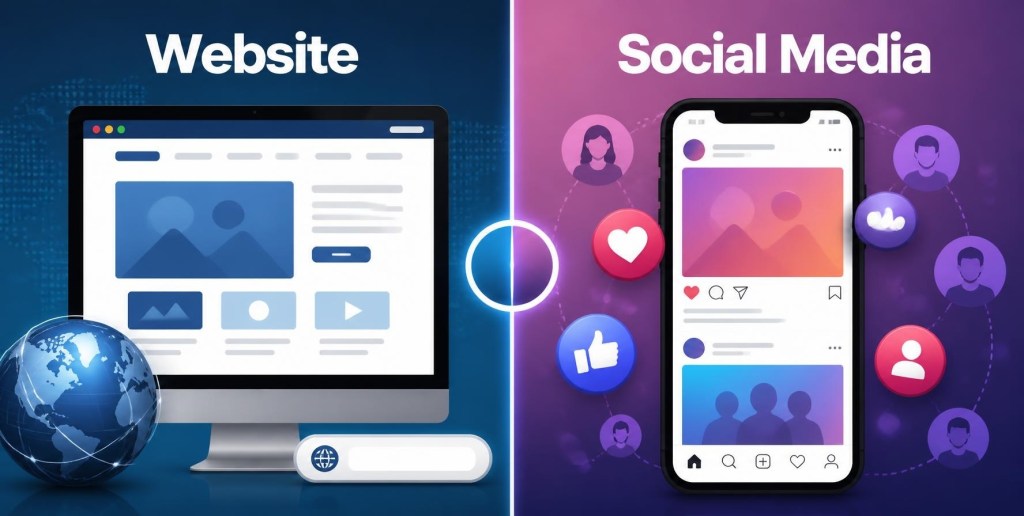
Social media has become an essential part of how businesses reach and interact with customers. At the same time, websites remain one of the most important digital assets for businesses that want to build credibility, attract search traffic, generate leads, and sell products or services.
The scale of both channels is significant. As of April 2026, an estimated 6.12 billion people worldwide were using the internet, while social media had reached approximately 5.79 billion user identities globally, according to DataReportal’s Digital 2026 Mid-Year Global Update.
That raises an important question for businesses: Do you need a website if you already have a strong social media presence?
The answer depends on what you want each channel to accomplish.
A website and social media are not identical marketing tools. They have different strengths, levels of control, and roles in the customer journey. Social media can help you reach people, build conversations, and distribute content, while a website gives you a central place to present your business, provide detailed information, capture leads, make sales, and control the customer experience.
So, rather than asking whether a website or social media is better overall, businesses should understand what each channel does best.
Website vs Social Media: What’s the Difference?
The simplest distinction is ownership and purpose.
A website is more than an online profile. It can serve as the central digital presence for your business, giving you control over your branding, content, customer experience, and business information. If you’re still considering the value of having a website, there are several reasons it can support your business beyond simply being visible online.
Social media is a third-party platform where your business maintains a presence. You can create a profile, publish content, interact with customers, and build an audience, but the platform controls the underlying environment, algorithms, features, policies, and distribution mechanisms.
This difference has important business implications.
A Website Is Your Owned Digital Presence
Your website gives you considerably more control over your online presence.
You can create dedicated pages for your products, services, locations, team, case studies, resources, FAQs, pricing, contact information, and other important business information.
You can also connect your website with tools such as:
- Contact and lead forms
- Online booking systems
- Payment gateways
- eCommerce platforms
- Customer accounts
- Email marketing systems
- Analytics tools
- CRM platforms
- Chat and customer support tools
- Marketing automation
This makes a website more than an online profile. It can become part of your business infrastructure.
According to Clutch’s research on small business websites, 83% of small businesses now have a website, compared with 64% in 2018. Among businesses that invested in a website, 39% said increasing sales and revenue was a reason for doing so, while 24% cited brand awareness and credibility.
Social Media Is Built for Reach and Interaction
Social media works differently.
Platforms are designed around content discovery, interaction, sharing, and community. Businesses can use them to publish updates, videos, images, announcements, educational content, and promotional campaigns.
The potential audience is enormous. According to DataReportal’s latest global digital data, approximately 5.79 billion social media user identities were recorded globally in April 2026.
That makes social media particularly useful for:
- Reaching new audiences
- Building communities
- Encouraging conversations
- Sharing short-form content
- Promoting products and services
- Generating social proof
- Responding to customers
- Testing content ideas
- Supporting paid advertising
Social media can therefore be an excellent discovery and engagement channel.
However, the business does not control the platform itself.
Search Works Differently Across the Two
Another important difference is how customers discover your business.
A website can create pages that target specific search queries, products, services, locations, and customer questions. These pages can be optimized for search engines and updated as the business evolves.
Social media discovery is generally driven more by platform algorithms, recommendations, followers, hashtags, shares, trends, and paid promotion.
Both can contribute to discovery, but they work differently.
According to BrightLocal’s 2026 consumer search behavior research, 84% of consumers searched online for a local business in the previous three months, while 75% used more than one channel during their most recent local business search.
This shows why businesses should think beyond a single digital channel. Customers may discover a company through social media, search, maps, reviews, AI tools, or another source before visiting the company’s website.
Websites Give You More Space to Explain Your Business
Social media posts are usually designed for quick consumption. Even when platforms allow long-form content, users are still operating within a feed-based environment.
A website gives you much more room to explain what your business does and why customers should choose it.
For example, a software development company can use its website to create dedicated pages for:
- Individual development services
- Industries served
- Technology expertise
- Client case studies
- Development methodologies
- Pricing information
- Frequently asked questions
- Company experience
- Customer testimonials
- Technical resources
You can then direct visitors toward specific actions, such as requesting a consultation or submitting a project inquiry.
Social media can promote those resources, but the website can serve as the deeper destination where customers find the complete information.
Businesses looking to increase their website visibility can also explore ways to increase website traffic through SEO, content marketing, social distribution, referrals, and other sources.
The Two Channels Serve Different Roles
This is why the website-versus-social-media debate can be misleading.
A website is generally stronger when you need:
- Ownership and control
- Detailed information
- Search visibility
- Lead generation
- eCommerce functionality
- Business credibility
- A consistent customer experience
- Long-term digital value
Social media is generally stronger when you need:
- Audience reach
- Engagement
- Community building
- Content distribution
- Real-time interaction
- Social proof
- Platform-based discovery
The real question is therefore not simply “website or social media?”
It is “Which channel is best suited to the business outcome I want to achieve?”
That distinction becomes clearer when you compare the two across specific areas such as branding, search visibility, lead generation, customer engagement, sales, analytics, and control.
Website vs Social Media: Quick Comparison
A website and social media can both help your business build an online presence, but they serve different purposes. The main difference is the level of control, the way customers discover your business, and how each channel supports the customer journey.
Ownership and Control
A website is a digital property that your business owns and controls. You can decide how it looks, what information it contains, how visitors navigate it, and which features or integrations it provides.
Social media operates on a third-party platform. You control your business profile and content, but the platform controls its algorithms, policies, features, and overall environment.
Branding and Customer Experience
Your website gives you greater freedom to create a consistent brand experience. You can control the design, layout, messaging, visuals, navigation, and calls to action.
Social media gives you branding opportunities too, but your content appears within a platform’s existing design and user experience. Your brand has to work within the platform’s format and limitations.
Search Visibility
Websites can help businesses appear in search engine results for relevant products, services, questions, and locations. Businesses can create dedicated pages and useful content designed around what potential customers are searching for.
Social media can also contribute to online discovery, but visibility is often influenced by platform algorithms, recommendations, engagement, followers, and trends.
According to BrightLocal’s 2026 consumer search behavior research, 52% of consumers started their most recent local search on Google Search, while 71% used Google Search at some point during their search journey.
Customer Engagement
Social media has an advantage when it comes to ongoing interaction. Customers can comment on posts, send messages, share content, participate in discussions, and interact with a brand regularly.
A website is generally more focused on providing information and guiding visitors toward an action, such as making a purchase, submitting an inquiry, booking an appointment, or requesting a consultation.
Lead Generation
A website can be designed specifically to generate leads. Businesses can use contact forms, landing pages, consultation requests, newsletter sign-ups, booking systems, and other conversion elements.
Social media can generate leads through direct messages, lead-generation features, links, advertising, and content. However, businesses often direct social media users to a website or landing page to complete the conversion.
You can also explore ways to increase website traffic to learn how different traffic sources can contribute to website growth and lead generation.
Selling Products and Services
A website provides more control when selling products or services online. Businesses can create product pages, service pages, pricing sections, shopping carts, payment options, booking systems, and customer accounts.
Social media can support product discovery and promotion, but the available selling features depend on the specific platform and its policies.
Content
Websites provide space for long-form and detailed content, including blogs, guides, case studies, service pages, product information, and resources.
Social media is better suited to short-form, visual, timely, and easily shareable content. Posts, videos, stories, reels, and other formats can help businesses capture attention and keep audiences engaged.
Analytics and Data
A website can provide detailed information about how visitors interact with your digital presence, including traffic sources, popular pages, conversions, and user behavior, depending on the analytics tools you use.
Social media platforms also provide analytics, but the data available depends on the platform and its reporting features.
Long-Term Value
A website can become a long-term digital asset for your business. You can continue improving its content, design, search visibility, functionality, and conversion opportunities as your business grows.
Social media is valuable for maintaining visibility and engagement, but businesses remain dependent on the platform’s policies, algorithms, audience behavior, and continued relevance.
Ultimately, a website is better suited to ownership, search visibility, detailed information, lead generation, and conversion, while social media is particularly effective for reach, engagement, community building, and content distribution.
Website vs Social Media: Ownership and Control
One of the biggest differences between a website and social media is who controls the environment.
With a website, your business controls the domain, website structure, content, navigation, design, functionality, and customer journey.
You can decide exactly what visitors see when they arrive and which actions you want them to take.
For example, a business can create a homepage that introduces the company, service pages that explain its offerings, case studies that demonstrate experience, and contact pages that encourage visitors to request a quote.
Social media works differently.
When you create a business profile on a social platform, you are using someone else’s infrastructure. The platform determines how content is displayed, what features are available, how posts are distributed, and what policies businesses must follow.
This does not make social media less valuable. It simply means businesses have less control over the environment.
Website vs Social Media for Branding
A website provides much more freedom when it comes to branding.
Businesses can control the layout, colors, typography, imagery, navigation, page structure, messaging, and overall user experience.
This makes it possible to create a digital experience that reflects the company’s positioning rather than adapting everything to a social platform’s interface.
Social media profiles can still play an important role in brand building. Consistent profile information, visuals, tone of voice, and content can help customers recognize and remember a business.
However, the overall experience remains constrained by the platform.
For businesses that want to establish a strong and consistent digital identity, the website can serve as the central brand destination while social media extends that identity to additional audiences.
Website vs Social Media for Search Visibility
Search visibility is another area where websites have an important advantage.
A business can create individual website pages around specific products, services, locations, questions, and topics. These pages can be optimized for search engines and updated as the business evolves.
For example, a web development company might create dedicated pages for:
- Custom web development
- eCommerce development
- SaaS development
- Healthcare software development
- Fintech development
- Web application development
- Different locations or markets
Each page can address a specific customer need and provide detailed information that helps both users and search engines understand the business.
Social media content can also appear in search results and contribute to brand visibility, but businesses have less control over how that content is discovered over the long term.
This distinction matters because search remains an important way for customers to find businesses.
According to BrightLocal’s 2026 consumer search behavior research, 52% of consumers started their most recent local search on Google Search, while 9% started on Google Maps. The study also found that 71% used Google Search at some point during their most recent local business search.
A website therefore gives businesses a place to build search-focused content that can continue attracting relevant visitors.
Businesses looking to expand this channel can also explore ways to increase website traffic through SEO, content marketing, social distribution, referrals, and other sources.
Website vs Social Media for Customer Engagement
Social media generally has the advantage when it comes to immediate interaction.
Customers can comment on posts, send direct messages, react to content, share posts, participate in discussions, and interact with other customers.
This creates opportunities for businesses to build communities rather than simply communicate information.
Websites tend to be more structured.
Visitors usually arrive with a particular goal. They may want to understand a service, compare products, read a case study, make a purchase, book an appointment, or contact the business.
That makes websites particularly useful for moving customers from information to action.
The two channels can therefore serve different stages of the customer journey.
Social media can start or strengthen the conversation, while a website can provide the detailed information needed to support a decision.
Website vs Social Media for Lead Generation
A website can be designed specifically around lead generation.
Businesses can use:
- Contact forms
- Quote request forms
- Consultation bookings
- Newsletter sign-ups
- Product inquiries
- Demo requests
- Downloadable resources
- Chat functionality
- Phone and email calls to action
These elements can be placed strategically throughout the customer journey.
A visitor who reads a service page, for example, can immediately be given the option to request a consultation.
Social media can also generate leads through direct messages, lead forms, profile links, advertising features, and calls to action.
However, the lead-generation experience is often more dependent on the capabilities and policies of the specific platform.
A website gives businesses more flexibility to design the entire conversion journey.
Website vs Social Media for Selling Products and Services
Websites can provide a complete environment for selling products and services.
An eCommerce website can include product catalogs, product descriptions, customer accounts, payment processing, shipping information, order tracking, reviews, and other functionality.
Service businesses can use websites for bookings, consultations, quote requests, subscriptions, and payments.
Social platforms increasingly offer shopping and business features as well, but the available functionality varies between platforms and markets.
A website gives businesses greater flexibility to build a sales process around their own requirements.
It can also become the central destination for traffic generated from social media, search engines, email campaigns, advertisements, and other marketing channels.
Website vs Social Media for Content
Websites provide greater freedom when it comes to the type and depth of content businesses can publish.
A company can create detailed guides, research reports, case studies, product documentation, service pages, comparison articles, FAQs, videos, and other resources.
This content can also be organized into a structure that makes sense for the business and its customers.
Social media is generally better suited to shorter, more immediate content formats.
Businesses can use posts, short videos, images, stories, polls, and other platform-specific formats to capture attention and encourage interaction.
For example, a company could publish a detailed industry guide on its website and then use social media to distribute short insights from that guide.
This gives the website the role of the primary content destination while social media helps increase its reach.
Website vs Social Media for Analytics
Both channels provide analytics, but the type and level of information available can differ.
Website analytics can help businesses understand where visitors come from, which pages they view, how they move through the website, which pages lead to conversions, and where potential customers leave the journey.
Businesses can then connect this information to specific goals such as sales, inquiries, bookings, or downloads.
Social media analytics can provide valuable information about reach, impressions, engagement, audience demographics, video views, clicks, and other platform-specific interactions.
The advantage of social analytics is that it can help businesses understand how audiences respond to content.
The advantage of website analytics is that businesses can connect visitor behavior more directly to their own conversion environment.
Using both can provide a broader picture of how customers discover and interact with a brand.
Website vs Social Media for Long-Term Value
A website can become a long-term digital asset for a business.
Businesses can continuously improve their pages, publish new content, add functionality, optimize search visibility, and expand the website as their requirements change.
Social media profiles can also accumulate followers, content, engagement, and brand recognition over time. However, businesses remain dependent on the platform’s continued availability, policies, algorithms, and features.
This is why ownership is an important part of the website-versus-social-media discussion.
A business does not have to choose between building an owned digital presence and participating on social platforms.
The more practical approach is to understand the strengths of each and use them for the purposes they serve best.
What Are the Advantages of Having a Website?
A website gives your business a central digital destination that you control. It can support marketing, sales, customer service, search visibility, and brand building from one place.
Here are some of the main advantages.
1. A Website Builds Business Credibility
Customers often look for information about a business before deciding whether to contact or purchase from it.
A professional website gives potential customers a place to verify who you are, what you offer, where you operate, and how they can contact you.
It can also provide important trust signals such as:
- Customer testimonials
- Reviews
- Case studies
- Client logos
- Certifications
- Industry experience
- Team information
- Business addresses
- Contact details
- Policies and guarantees
According to BrightLocal’s 2025 consumer search behavior research, 85% of consumers consider contact information and opening hours important when researching local businesses.
This makes accurate and easily accessible business information an important part of the online customer experience.
2. A Website Can Improve Search Visibility
One of the biggest advantages of having a website is the opportunity to attract visitors through organic search.
Businesses can create dedicated pages for their products, services, locations, industries, and customer questions.
For example, a web development company could create separate pages targeting different development services instead of trying to explain everything on a single social media profile.
Useful website content can also continue attracting visitors after it has been published.
A well-optimized article, service page, or resource may generate organic traffic for months or years, depending on the topic, competition, search demand, and quality of the content.
This gives businesses an opportunity to build a sustainable source of discovery rather than relying entirely on paid promotion or social algorithms.
3. A Website Gives You More Control Over the Customer Experience
A social media profile follows the design and functionality of the platform.
A website gives you much greater control.
You can decide how visitors move from one page to another, where calls to action appear, what information is presented first, and how the entire experience supports your business objectives.
For example, a professional services company could guide a visitor through:
Service page → Case study → Client testimonial → Consultation form
An eCommerce business could create a journey such as:
Product page → Product comparison → Reviews → Checkout
This ability to design the customer journey can be particularly valuable when the purchase decision involves research or multiple steps.
4. A Website Can Generate Leads Around the Clock
A website does not need to be available only during business hours.
Potential customers can visit a service page, submit an inquiry, request a quote, book an appointment, download a resource, or make a purchase whenever it is convenient for them.
This does not mean a website automatically generates leads simply by existing.
Traffic, content quality, search visibility, offers, user experience, and calls to action all influence performance.
However, once those elements are in place, the website can continue working as a lead-generation channel without requiring someone to manually respond to every initial interaction.
5. A Website Gives You Space to Explain Complex Products and Services
Some businesses have products or services that cannot be adequately explained in a short social media post.
Consider businesses operating in areas such as:
- Software development
- Financial services
- Healthcare
- Legal services
- Consulting
- Manufacturing
- B2B technology
- Real estate
- Education
Potential customers may need detailed explanations, specifications, comparisons, examples, pricing information, documentation, or case studies before they are ready to make a decision.
A website gives businesses the space to provide this information in an organized way.
Social media can then be used to highlight individual insights and direct interested audiences toward the deeper resources on the website.
6. A Website Can Support Direct Online Sales
For businesses selling products or services online, a website can become a complete sales environment.
Depending on the business model, this can include:
- Product catalogs
- Shopping carts
- Online payments
- Subscriptions
- Bookings
- Digital downloads
- Customer accounts
- Order tracking
- Product reviews
- Personalized recommendations
This gives businesses more control over how their products and services are presented and how customers move through the buying process.
7. A Website Creates a Central Home for Your Digital Marketing
Businesses often use several channels to reach customers.
They may publish content on social media, run advertising campaigns, send emails, participate in industry directories, publish videos, and invest in SEO.
A website can act as the central destination connecting these activities.
For example, a social media post can send users to an article. The article can direct readers to a service page. The service page can encourage them to request a consultation.
This creates a connected digital ecosystem rather than treating every marketing channel as a separate activity.
Businesses that are actively trying to increase visibility can also use resources such as ways to increase website traffic to build a broader acquisition strategy.
8. A Website Can Become a Long-Term Business Asset
Your website can evolve as your business evolves.
You can add new services, publish new content, expand into new locations, introduce eCommerce functionality, create customer portals, and integrate new technologies.
This makes the website more than a digital brochure.
It can become an important part of your business infrastructure.
The key is to maintain it. Businesses should periodically review their content, design, performance, security, and functionality rather than allowing the website to become outdated.
If your website needs improvement, our guide on reasons to update your website covers some of the signs that it may be time for a refresh.
What Are the Advantages of Social Media?
While websites provide ownership and control, social media has a different advantage: access to large, active audiences and built-in mechanisms for interaction.
For many businesses, social media is one of the fastest ways to put content in front of potential customers.
1. Social Media Can Help You Reach Large Audiences
Social platforms give businesses access to audiences that already spend significant amounts of time consuming and sharing content online.
According to DataReportal’s Digital 2026 Mid-Year Global Update, approximately 5.79 billion social media user identities were recorded globally in April 2026.
This scale creates opportunities for businesses to reach people who may not yet be familiar with their brand.
The challenge is standing out.
Simply creating an account does not guarantee visibility. Businesses need useful content, consistent publishing, audience understanding, and an appropriate distribution strategy.
2. Social Media Makes Customer Interaction Easier
Social platforms are designed for interaction.
Customers can comment on posts, send messages, react to content, share posts, participate in polls, and ask questions.
This gives businesses opportunities to interact with customers in a more informal and immediate environment.
For some brands, these conversations can also provide valuable insights into customer preferences, concerns, questions, and expectations.
A business can use those insights to improve its products, services, content, and website.
3. Social Media Helps Build Communities
A website primarily serves visitors who arrive looking for information or taking a specific action.
Social media can help businesses build an ongoing audience.
Followers may see a company’s content repeatedly, interact with other followers, participate in discussions, and become familiar with the brand before they are ready to buy.
This can be especially valuable for brands where community and personality play an important role.
Industries such as fashion, food, travel, fitness, entertainment, education, and consumer products can often benefit significantly from this type of engagement.
Businesses can explore different channels through resources such as popular social media platforms and select platforms based on where their target customers are most active.
4. Social Media Is Effective for Content Distribution
Creating useful content is only one part of content marketing.
You also need to distribute it.
Social media can help businesses promote:
- Blog articles
- Videos
- Product launches
- Case studies
- Industry insights
- Events
- Webinars
- Offers
- Company announcements
- Customer stories
For example, a business could publish a detailed guide on its website and then create several social posts based on different insights from that guide.
This allows one piece of website content to support multiple social media updates.
5. Social Media Can Strengthen Social Proof
Customers often look for evidence that other people trust and use a business.
Social media can provide visible indicators of activity and customer interaction.
Comments, customer posts, tagged content, discussions, reviews, and shared experiences can all contribute to how people perceive a brand.
Reviews are particularly important in local business decisions. BrightLocal’s 2025 Local Consumer Review Survey found that 74% of consumers use two or more review sites when researching local businesses.
Social media can complement this broader review ecosystem by giving customers additional opportunities to see how a business interacts with its audience.
6. Social Media Can Support Paid Advertising
Social platforms provide sophisticated advertising options that can help businesses reach specific audiences.
Depending on the platform, businesses may be able to target audiences based on factors such as interests, demographics, behaviors, location, or previous interactions.
This can make social advertising useful for:
- Brand awareness
- Product promotion
- Lead generation
- Website traffic
- Event promotion
- Retargeting
- Sales campaigns
However, paid social advertising should generally be connected to a clear business objective.
Sending every campaign to a generic homepage, for example, may be less effective than directing users to a relevant product page, landing page, service page, or lead form.
7. Social Media Provides Fast Feedback
One of social media’s biggest advantages is speed.
A business can publish something and begin receiving reactions, questions, comments, and other forms of feedback almost immediately.
This can help businesses test ideas before investing heavily in them.
For example, a company considering a new service could publish educational content around the problem it solves and monitor the questions and reactions it receives.
Those insights could then inform the service page, website content, advertising campaigns, and broader marketing strategy.
Social media therefore isn’t only a promotional channel. It can also be a useful source of audience intelligence.
8. Social Media Can Humanize a Brand
Websites are often structured around business information and conversion.
Social media provides more opportunities to show the people and personality behind the business.
Businesses can share:
- Behind-the-scenes content
- Employee stories
- Company culture
- Customer stories
- Product development
- Events
- Milestones
- Founder insights
This can make a business feel more accessible and relatable.
For companies operating in competitive markets, showing the human side of the brand can help create stronger connections with potential customers.
The Bottom Line
Websites and social media provide different types of value.
A website gives businesses greater control, deeper content capabilities, search opportunities, conversion functionality, and a long-term digital asset.
Social media provides reach, interaction, community building, content distribution, audience feedback, and opportunities for real-time engagement.
Understanding these differences makes it easier to decide where each channel should fit into your digital strategy.
Website vs Social Media: Which Is Better for Your Business?
There is no universal winner between a website and social media because they solve different business problems.
The better choice depends on what you want to achieve.
If your priority is building a long-term digital presence that you control, a website is the stronger foundation. If your priority is reaching audiences, encouraging conversations, and distributing content, social media can be particularly effective.
For most businesses, however, the question should not be whether to choose one over the other. It should be how each channel can contribute to the customer journey.
A Website Is Better for Ownership and Control
A website gives you control over your digital environment.
You can decide how your brand is presented, how information is organized, which features are available, and what customers can do when they visit.
You are not limited to the layout, content formats, or functionality provided by a social platform.
This becomes increasingly important as your business grows and your digital requirements become more sophisticated.
A Website Is Better for Search Visibility
If your business depends on people finding products, services, information, or local businesses through search engines, a website provides an important foundation for SEO.
You can create dedicated pages around specific search intent and continually improve them based on customer needs and search performance.
For local businesses in particular, this can be valuable because customers frequently research businesses online before making decisions.
According to BrightLocal’s 2026 consumer search behavior research, 84% of consumers searched online for a local business during the previous three months.
A website can give those customers a place to find detailed information after discovering your business through search, maps, reviews, social media, or another channel.
Social Media Is Better for Engagement and Community
If your objective is to have ongoing conversations with an audience, social media often has an advantage.
People can follow your account, interact with posts, comment on content, share updates, and communicate directly with your business.
This makes social platforms particularly useful for brands that depend heavily on community, visual content, entertainment, trends, or frequent customer interaction.
A Website Is Better for Detailed Customer Information
A social media profile can introduce your business, but a website can provide a much deeper picture.
You can create dedicated pages for every major product, service, market, location, or customer segment.
You can also publish case studies, technical resources, guides, FAQs, testimonials, policies, and other information that may be difficult to organize effectively on a social platform.
This becomes particularly important for products and services that require research before purchase.
A Website Is Better for Conversion Control
A website allows you to design the customer journey around specific business objectives.
You can decide where visitors go after reading a page and what action you want them to take.
For example:
- Read a service page → Request a quote
- Read a case study → Book a consultation
- View a product → Add it to cart
- Read an article → Subscribe to an email list
- Visit a location page → Get directions or contact the business
Social media can send people into these journeys, but the website gives you more control over what happens after the visitor arrives.
Social Media Is Better for Content Discovery and Distribution
Even excellent website content needs distribution.
Social media can help businesses introduce that content to existing followers and potentially reach new audiences.
A business can turn one detailed website article into several social posts, short videos, graphics, discussions, or other pieces of content.
This can extend the reach of content without requiring a completely new topic for every post.
A Website Is Better as a Long-Term Digital Foundation
Social media trends and platforms can change quickly.
Features are added and removed. Algorithms change. User behavior evolves. New platforms emerge while others become less relevant.
Businesses therefore have limited control over the long-term environment of a social platform.
A website provides a more stable digital foundation.
You can redesign it, add functionality, publish new content, improve performance, and adapt it as your business changes.
That makes the website particularly valuable as a long-term business asset.
Social Media Is Better for Real-Time Interaction
When customers want to ask quick questions, respond to an announcement, comment on content, or participate in a discussion, social media can provide a more immediate environment.
This can be particularly useful for businesses that depend on frequent communication with their audience.
However, important or frequently requested information should still be available on the website where customers can find it easily.
Website vs Social Media: The Best Choice Depends on Your Goal
There is no single answer to whether a website or social media is better for your business. The right choice depends on what you want to achieve.
If your goal is to establish a central online presence, build credibility, provide detailed business information, or improve your visibility in search results, a website is usually the stronger choice. It gives you a dedicated space where customers can learn about your business, explore your products or services, read testimonials, contact you, and take the next step.
A website is also better suited to goals that require greater control over the customer journey. Whether you want visitors to request a quote, book an appointment, sign up for a service, or make a purchase, you can design the website around those actions.
For businesses focused on selling products or services online, a website can provide the infrastructure needed for eCommerce, payments, bookings, customer accounts, and other transactions.
Social media becomes particularly valuable when your primary goal is to build an audience and maintain ongoing interaction. Platforms can help businesses distribute content quickly, encourage conversations, showcase their brand personality, and build communities around their products or services.
Social media can also be useful for reaching people who may not already know about your business. Through recommendations, shares, platform discovery, creators, and paid advertising, your content can reach potential customers beyond your existing audience.
Consider the goal first:
- If you want to build credibility, a website provides a more complete and controlled business presence.
- If you want to improve organic search visibility, a website gives you greater opportunities to create and optimize searchable content.
- If you want to provide detailed information, a website offers more space and flexibility.
- If you want to generate leads through forms, bookings, consultations, or inquiries, a website can be built around those conversions.
- If you want to sell products or services directly online, a website provides greater control over the transaction experience.
- If you want to build a community, social media can make ongoing interaction easier.
- If you want to distribute content quickly, social media can help you reach audiences through feeds, recommendations, and sharing.
- If you want real-time feedback and conversations, social media provides a more interactive environment.
- If you want to showcase your brand personality, social media allows you to communicate through frequent, visual, and conversational content.
For most businesses, the decision does not have to be either-or. A website can serve as the central digital foundation, while social media can help attract attention, engage audiences, and distribute content.
The stronger approach is to understand what each channel does best and use it according to your business goals.
Conclusion: Website or Social Media?
The website-versus-social-media debate is ultimately not about choosing a winner.
A website and social media serve different purposes.
A website gives your business an owned digital presence where you can build credibility, publish detailed information, attract search traffic, generate leads, sell products and services, and control the customer experience.
Social media helps you reach audiences, build communities, distribute content, interact with customers, and strengthen brand awareness.
For businesses that want a sustainable digital presence, the website should generally serve as the central foundation, while social media can extend its reach and create ongoing engagement.
The important thing is to avoid treating either channel as a standalone solution.
Your website should give customers a clear place to learn, evaluate, and take action. Your social media presence should help more people discover your brand and stay connected with it.
If you are planning to build or improve your website, you can explore top web development companies to find best web development companies based on your project’s requirements and expertise.
And if your website already exists, regularly reviewing its content, functionality, design, and performance can help keep it aligned with changing customer expectations. Our guide to reasons to update your website covers some of the key situations when a website may need an update.
Ultimately, your website and social media presence should work toward the same goal: making it easier for the right customers to discover your business, understand what you offer, trust your brand, and take the next step.
 TechX
TechX 
Leave a comment